
About four of every five housing units in Santa Ana were built before 1980. If your house belongs to that group, the valves, fittings and pipe runs behind its walls may be the first ones ever installed, or may carry old repairs, and one that fails can wet a long stretch of wall or floor unseen.
Service area · Santa Ana, CA
Water Damage Repair in Cowan Heights, CA
A supply line has split behind a wall or under a sink, the floorboards beside it feel spongy, and a dark patch is creeping along the hallway. Water damage restoration in Cowan Heights, CA, starts with where that water goes after it leaves the line: into the wallboard, the flooring, and the slab or crawlspace under your single-family home. Calling before the wet area grows past the first room keeps the drying work to one wall and one stretch of floor.
What you are seeing
A split line wets more than the spot where it drips
Household water pressure pushes through a cracked fitting, a worn flex hose or a pinhole in a copper run for as long as the line stays open. Behind a wall or under a sink, your first sign is a cupped floorboard, a bubbled finish or a stale scent, while the water meter keeps spinning.
- Under a sink
A cracked angle stop or a worn hose drenches your vanity floor, then the planks in front of it.
- Behind a wall
A pinhole in a copper run sprays the stud bay and the back of your wallboard long before the surface shows a mark.
- Above a ceiling
A failed line in the attic or on an upper floor saturates the batts overhead, and they hold that water against the ceiling you live under.
- Below the floor
A line under the slab or inside a crawlspace soaks the soil side first, far from the break you eventually find.
Mending the line belongs to a plumber, and water damage restoration in Santa Ana picks up where the pipe work leaves off: with the water already in your walls and floors.
Loss risk
How a slab and a crawlspace each hide the wet area
Whatever your house sits on decides where the water gathers and how long it stays hidden.
- Slab
Water travels laterally under your flooring and along the foot of each wall, so the wet area extends wider than any mark and drenches the covering from below.
- Crawlspace
Water drips onto the soil and the underside of the floor deck, saturating batts and joists while the rooms you live in look normal.
- Vanity and pantry floors
The enclosed floor under a sink base traps water against the deck, where it keeps feeding the same wet spot.
Either way, the stain you see understates the damage. Wet wallboard softens to chalk at its lower margin, swollen planks lift at their joints, and framing lumber that stays wet starts to rot.
A split line keeps wetting the wall, the floor and the foundation under it, and calling first decides how much of them dries in place.
(657) 332-2040Property type
Why the age of your plumbing matters
Call when you spot the first stain, stale scent or lifted plank, so meter checks follow the water through your wall and floor and not only along the surface mark.
Restoration scope
What professional restoration covers in a single-family house
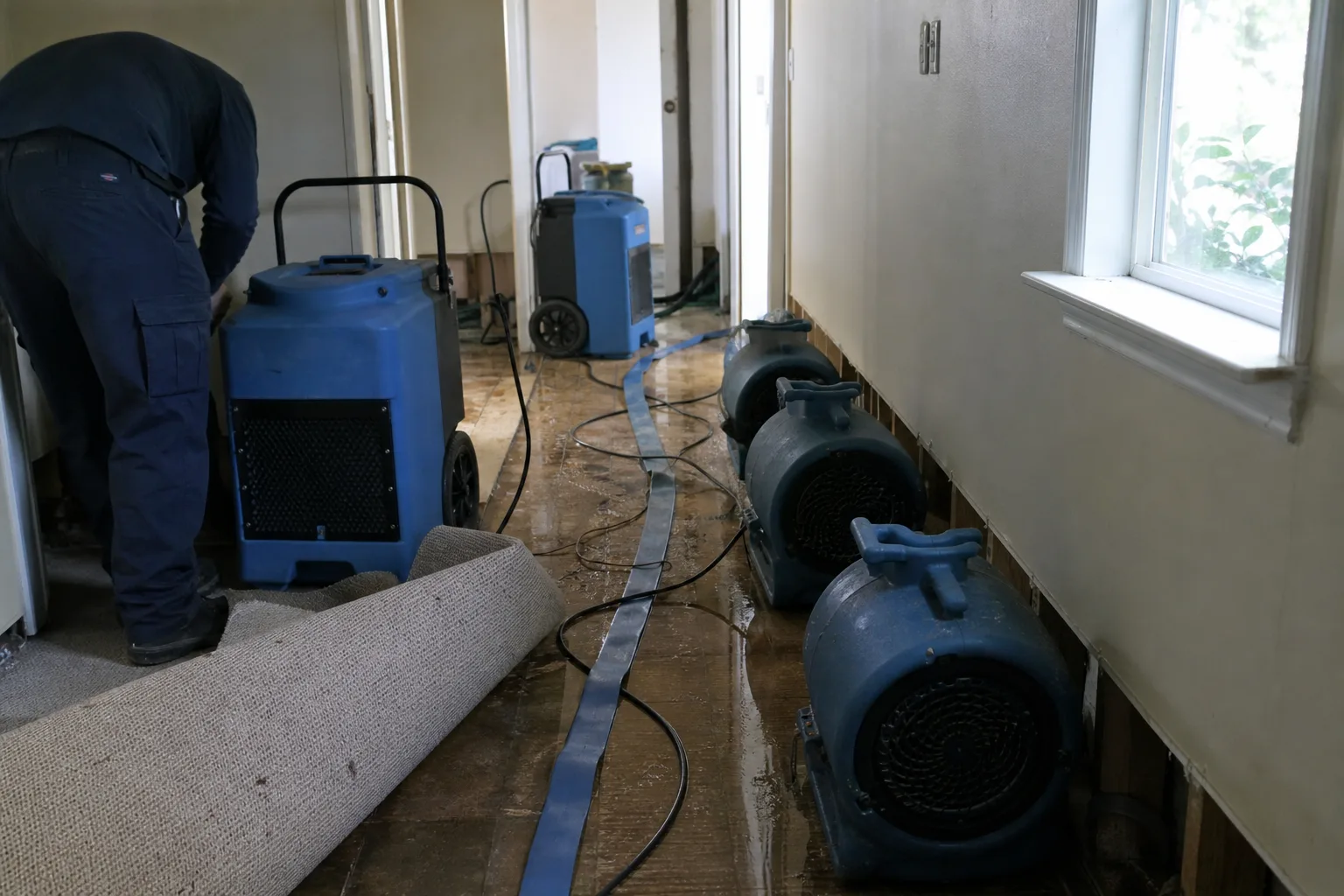
Restoration treats the whole wet area, not only the drip. Water extraction and drying in Santa Ana follows the water into every material it reached.
- Lifting the water
Powerful suction pulls water from your flooring, vanity floors and low spots before it wicks any higher.
- Outlining the damage
Meter checks room by room trace the true edge of the wet zone, including parts hidden from view.
- Stud-bay drying
Dehumidification and steady airflow pull the water out of your wall bays, the floor deck and the joists.
- Under-floor drying
Drying reaches the underside of the deck and the joists from below, so sound flooring above can stay put.
- Selective cut-out
Pieces that soaked through and will not dry get cut away, which opens the bay behind them to airflow.
Pipe and appliance failures, from a cracked hose to a failed valve, all fall under pipe and appliance water damage in Santa Ana work. Each step is mitigation: it removes water and dries structure, and the line itself goes back to a plumber.
Service sequence
How a drying job moves from first readings to a dry house
Outlining
Meter checks trace the edge of the wet zone through each room of your house before anything moves.
Lifting
Suction pulls loose water off the floor and out of the underlayment and carpet cushion below it.
Opening up
Soaked pieces come out, so airflow reaches the bays and the deck behind them.
Drying
Dehumidification runs across the wet zone while repeat checks show which materials are letting go of water and which still hold it.
Sign-off
Closing checks match each material to a dry reference room before the drying work stops.
If one wall stops improving, a second leak or trapped water is feeding it, and the drying plan shifts to reach that spot.
Local detail
A supply line is not the only way water gets in
Water that leaks past flashing or a window casing soaks the attic batts and the ceiling beneath them just as a failed pipe soaks a wall. Whichever way water entered your Orange County home, it spreads under the planks, so call about every damp room and not only the first one you found.
Triage order
Why waiting widens the wet area
A line that keeps running, or a wall that stays wet, adds rooms to the work on your house.
Wallboard that could have dried turns into a cut-out, planks that could have stayed flat cup past saving, and a damp crawlspace keeps feeding moisture up into the joists.
Once the first stain shows, your call decides whether the job stays one wall and one floor or spreads to the rooms around them.
Common questions
Questions from Cowan Heights homeowners about a failed supply line
Can a floor over a crawlspace dry without opening it up?
Often yes. Drying reaches the underside of the floor deck and the joists from below, which lets sound flooring stay in place. Boards that have buckled or soaked through come up so the framing under them can dry.
Why does the wet area run past the stain on a wall?
Water follows the lowest path it can find and wicks up the wall from its foot. Meter readings show the true outline, which is almost always larger than the mark you see.
Does a slab foundation keep water from reaching your flooring?
No. Water spreads across the top of a slab and wicks up into the wall feet and the flooring above, and a slab that stays wet keeps sending moisture upward into whatever you put on it.
Is water from a clean supply line harmless?
It starts as drinking water. The longer it sits in wallboard, carpet cushion and dust, the more it sours, so drying that begins early protects more of your house.
Does restoration include repairing the line?
No. Repairing the line is plumbing work. Restoration removes the water the line released and dries the structure it reached.
What the local conditions mean for a property in Cowan Heights
- Housing stock · across Santa AnaAbout 80 percent of Santa Ana's housing units were built before 1980: 24.5 percent in the 1970s, 22.2 percent in the 1960s, 20.1 percent in the 1950s and 13.5 percent before 1950.Supply lines, drains and shutoff valves in homes of that age are often original or repaired in sections, and a failure behind a wall or under a floor can wet more material than the visible stain suggests.Call when you see a stain, a musty smell or a warped floor, so the wet area is traced through the wall and floor and not only along the visible mark.
Service area
Cowan Heights on the map
Water damage keeps spreading until it is dried.
Call from Santa Ana before the water reaches the next room, the subfloor or the framing behind your walls.