
A converted garage often keeps its old slab edge, a former door opening and flooring laid over concrete. Water that crosses that threshold sits against the slab edge and under the new flooring.
Service · Santa Ana, CA
Basement Water Removal in Santa Ana, CA
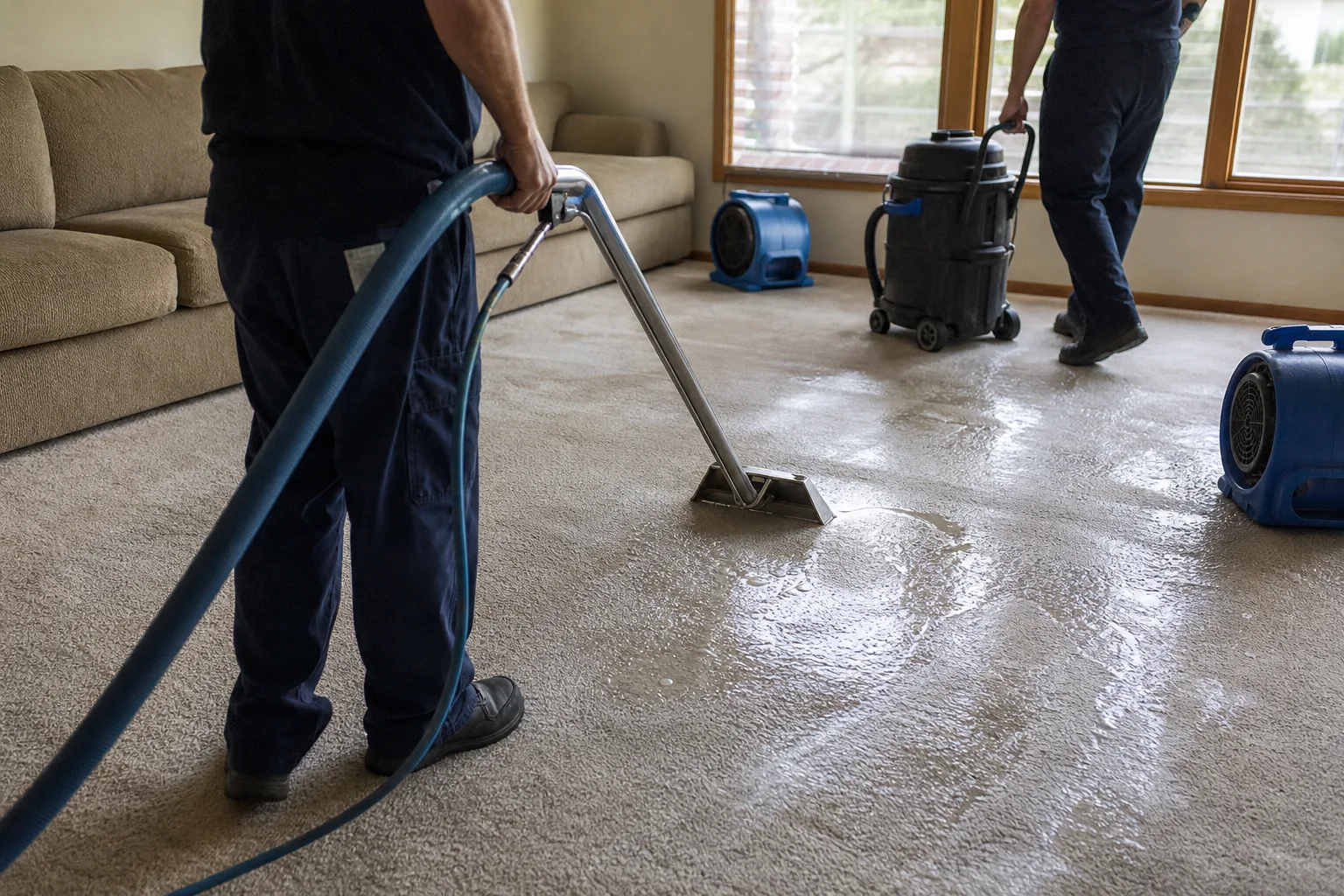
Water is rising through your floor or seeping in at the wall of a below-grade room, and it has nowhere to drain. Basement water removal clears the standing water from that lower level of your Santa Ana building and then dries the walls and slab it reached. Surface water in a lower level is what removal clears first, so the first wet wall base is the cue to call.
What you are seeing
Water pooling in the lowest room of the building
Some multi-level and commercial Orange County buildings include a lower level, a parking level or a garage converted to living space. When water enters one of these, you find it gathered at the lowest point, where it stays.
- Seepage at the wall
Water pushes through the joint where the wall meets the floor.
- Water rising at the floor
Water comes up through cracks or a floor drain that has backed up.
- Stairwell inflow
Water runs down a stairway and fills the room from the bottom.
- A burst line overhead
Water from a failed pipe above drains down into the lowest room.
Property type
Parking levels, converted garages and lower office floors
A lower retail or office floor has carpet tile, office dividers and stored inventory, and each takes water at a different rate. From the doorway you cannot see which of them still holds it.
Water below grade has nowhere to run, and whatever it touches stays wet.
(657) 332-2040Loss risk
What water at the lowest point soaks first
Below-grade water presses against concrete walls and floors and soaks every finish that touches them. Your belongings on the floor go with it. Wall framing and board along the floor sit in the water and take it up.
Cardboard, fabric and stored wood wick it higher, carpet laid on concrete holds the slab wet and the odor in, and wood at the bottom of a stairway begins to rot.
Restoration scope
Clearing starts at the lowest point
Removal works from the lowest point outward, because water left in the deepest part keeps wetting everything around it.
- High-volume removal
High-volume extraction clears deep standing water and the thin layer left on concrete.
- Wall-base extraction
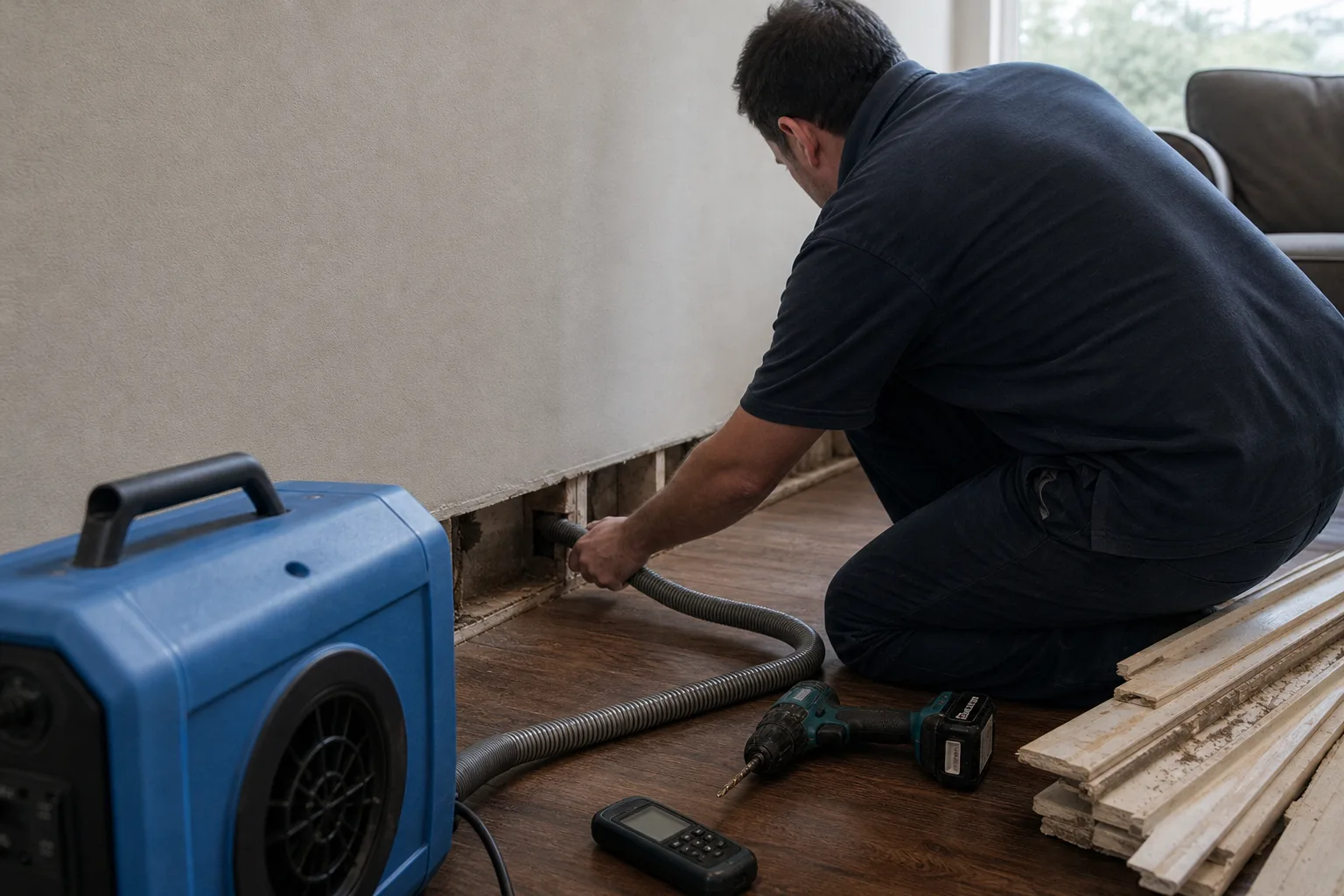
Water held in the bottom of the wall is drawn out before it climbs.
- Wall and slab survey
Moisture mapping traces water into the slab, the wall bases and stored materials.
- Sustained drying
Dehumidification and moving air draw the remaining moisture out of concrete and framing.
Service sequence
Deepest water first, walls and slab after
Lowest point cleared
Extraction starts where the water is deepest and moves toward the doorway.
Walls and slab surveyed
The survey shows how far the water went into the wall bases and the floor.
Wet finishes sorted
Carpet, cushion and board that cannot dry leave the room.
Drying to a standard
Dehumidification and airflow continue until the concrete and the wall bases read dry.
Local detail
When a creek reach floods a lower level
Santiago Creek runs through Santa Ana to its confluence with the Santa Ana River. If flood water reaches a lower level of your building, call as soon as water has entered, so the wet materials are located and dried and not only the standing water removed.
Triage order
Below-grade water moves into the walls
Standing water in a room below grade does not evaporate on its own, and every day it sits it moves further into the walls and your stored belongings.
A shallow film becomes a soaked slab and wet wall bases. A lowest point holding water is reason to call: extraction starts there, and your stored belongings wick up what the water touches.
Scope: Emergency extraction and structural drying clearance only. Structural rebuild and finishing carpentry are contracted separately.
Service area
Santa Ana ZIP codes
- 92701
- 92703
- 92704
- 92705
- 92706
- 92707
Every responding technician is independent. Before work begins, confirm the technician's license, insurance and pricing with them directly.
Common questions
Lower levels, stored belongings and floor drains
Do all Santa Ana buildings have a basement?
No. Most homes sit on a slab or a raised foundation. A lower level shows up in some multi-level and commercial buildings and in garages converted to living space.
Does the water need to be gone before drying?
Extraction comes first because standing water keeps feeding the walls. Drying then takes the moisture out of the concrete and framing.
Do stored belongings affect the work?
Wet cardboard and fabric wick water back up from the floor, so the survey includes the materials around the water.
Can you use the lower level while it dries?
The room is part of the wet zone until measurements show the concrete and framing have released their water, so the work treats it as one job from first removal to final reading.
Does a floor drain change the work?
A floor drain that backed up can bring in more than rainwater, which changes what has to be cleaned. The first removal pass and the survey sort out which case you have.
Water damage keeps spreading until it is dried.
Call from Santa Ana before the water reaches the next room, the subfloor or the framing behind your walls.